The Effect of Angles on Sling Capacities
The effect of sling angles on sling capacity refers to how tension increases on each sling leg as the sling angle decreases from vertical. When sling angles become smaller, each sling leg must carry more force, which reduces the safe working capacity of the sling.
Using slings at an angle can quickly become catastrophic if the angle is not considered prior to selecting which sling to use. Understanding the effect of angles on sling capacities is a critical part of safe rigging.

The sling angle has a large impact on the sling lifting capacity.
Given that, the most desirable angle of lift is one that approaches 90 degrees. The inverse relationship between the angle of lift and sling tension also dictates that lifts with angles of less than 30 degrees from horizontal are not recommended.
However, if you can measure the angle of the sling or the length and height of the sling as rigged, you can determine the properly rated sling for your lift. This is referred to as the Load Angle Factor (LAF) or Tension Factor (TF). To determine the correct sling capacity, you must first calculate the tension placed on each sling leg.
How Sling Angles Affect Sling Tension
Sling angle dramatically affects the tension placed on each sling leg. The smaller the sling angle, the greater the tension. The table below shows how sling tension increases as sling angles decrease and how that relates to crane rigging and lifting operations.
| Sling Angle |
Tension on Each Sling Leg |
Safety Recommendation |
| 90° |
Lowest tension |
Ideal lifting angle |
| 60° |
Moderate tension |
Common rigging configuration |
| 45° |
High tension |
Use caution |
| 30° |
Very high tension |
Minimum recommended angle |
| Below 30° |
Extremely high tension |
Not recommended |
How Sling Angle Affects Tension on Each Sling Leg
When lifting a load with multiple sling legs, the tension placed on each sling increases as the sling angle decreases. This occurs because the load force is distributed through the sling legs at an angle rather than vertically. As the angle becomes smaller, each sling leg must carry a greater share of the load.
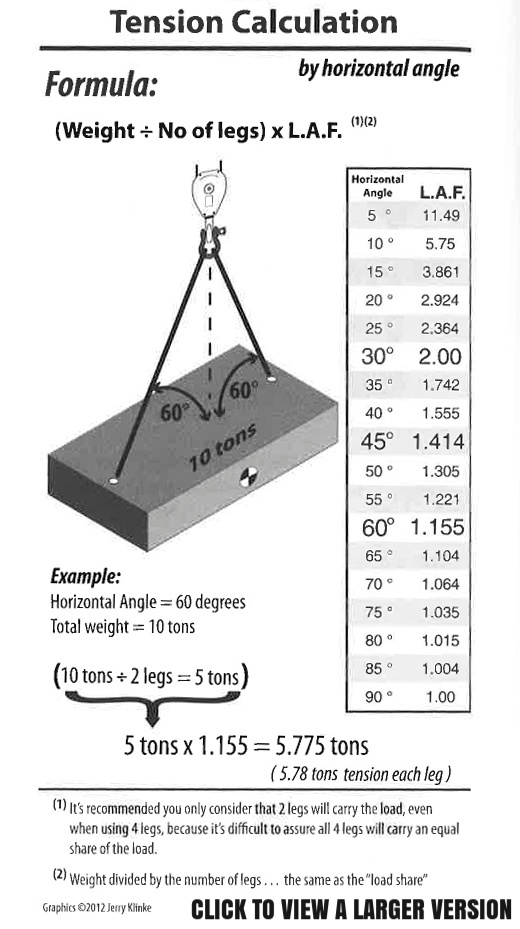
The diagram above illustrates how sling tension can be calculated using the Load Angle Factor (LAF). The tension calculation formula used is:
(Load Weight ÷ Number of Sling Legs) × Load Angle Factor
To calculate sling tension, first divide the total load weight by the number of sling legs supporting the load. Then multiply that value by the load angle factor corresponding to the sling’s horizontal angle.
Tension Calculation Example
In the example shown in the graphic:
First, divide the load weight by the number of sling legs:
10 tons ÷ 2 legs = 5 tons per sling
Next, find the Load Angle Factor for a 60° sling angle, which is 1.155.
Finally, multiply the load per sling by the load angle factor:
5 tons × 1.155 = 5.775 tons
This means each sling leg must be capable of supporting approximately 5.78 tons of tension, even though the load itself is only 10 tons.
Why Tension Calculation Matters
As sling angles decrease, the load angle factor increases rapidly. This results in significantly higher tension on each sling leg. For this reason, rigging best practices recommend maintaining sling angles above 30° from horizontal whenever possible. Angles below this threshold dramatically increase sling tension and can overload lifting equipment.
Understanding how sling angles affect tension is critical for selecting properly rated slings and maintaining safe lifting operations.
The Steps to Calculating the Required Sling Capacity for a Lift
When a load is lifted with multiple slings, each sling leg carries only a portion of the load. However, as the sling angle decreases, the tension on each sling leg increases. To determine the correct sling capacity, you must account for this increase in tension.

Sling angle chart, showing how sling angles increase tension and reduce lifting capacity using tension factors and reduction factors.
Step 1: Determine the Load Per Sling
Start by dividing the total load weight by the number of sling legs supporting the load. For example, if the total load weight is 1,000 lbs and the rigging configuration uses two sling legs, the load per sling would be 1,000 ÷ 2 = 500 lbs per sling.
Step 2: Determine the Sling Angle
Measure the sling angle from the horizontal plane. Once the angle is known, use a sling angle chart to find the corresponding Tension Factor (TF). The tension factor shows how much additional force is applied to each sling leg due to the angle of the lift.
Step 3: Calculate the Minimum Sling Rating
Multiply the load per sling by the tension factor to determine the minimum sling capacity required. The formula is:
Load Weight per Sling × Tension Factor = Minimum Required Sling Capacity.
For example, if the load per sling is 500 lbs, the sling angle is 30°, and the tension factor is 2.0, then the calculation is 500 × 2.0 = 1,000 lbs required capacity per sling.
Calculating Reduced Sling Capacity
Sling angles can also reduce the effective lifting capacity of a sling. This is calculated using the Reduction Factor (RF).
Step 1: Measure the Sling Geometry
Measure the sling length (L) and the sling height (H). Then calculate the reduction factor using the formula:
Reduction Factor (RF) = Height (H) ÷ Length (L).
Step 2: Calculate the Reduced Sling Capacity
Multiply the sling’s rated capacity by the reduction factor to determine the sling’s effective capacity at that angle. The formula is: Rated Sling Capacity × Reduction Factor = Reduced Sling Capacity. For example, if the vertical sling rating is 6,000 lbs and the reduction factor is 0.667, the calculation is 6,000 × 0.667 = 4,000 lbs of lifting capacity per sling.
Why Sling Angles Matter
As sling angles decrease, tension increases dramatically. For this reason, most rigging guidelines recommend keeping sling angles above 30° from horizontal whenever possible. Angles below this point significantly increase sling tension and can overload rigging equipment.
Frequently Asked Questions About Sling Angles
What is the formula for sling tension?
Sling tension is calculated by dividing the total load weight by the number of sling legs and then multiplying the result by the load angle factor (LAF).
What happens when sling angles are too small?
When sling angles decrease, tension on each sling leg increases dramatically. This can overload the sling and lead to rigging failure.
Why are sling angles below 30 degrees dangerous?
Angles below 30 degrees create extremely high tension forces that may exceed the working load limit of the sling.
What is the safest sling angle for lifting loads?
Angles closer to 90 degrees create the least tension on sling legs and are considered the safest configuration.
How do riggers calculate sling tension?
Riggers calculate sling tension using the Load Angle Factor or tension factor, which accounts for the angle of the sling and the weight of the load.
Get Expert Rigging Support
At LGH, we pride ourselves on being not just equipment providers but rigging and lifting solution providers. If you have a question about your lift, reach out to our trained staff of lifting experts!
With over 25 rigging warehouses across North America and 60+ rental reps, your next jobsite solution is at LGH. You can locate your nearest LGH representative here.
Download the LGH catalog for more information about rigging equipment types and specifications. For further support, call the Lifting Experts at 800-878-7305 today.
LGH is North America’s largest single organization devoted exclusively to the provision of lifting and moving equipment for rent. LGH holds the most comprehensive inventory for hoisting, rigging, jacking, pulling, material handling, and safety equipment. With over 90,000 pieces, discover your next project solution at RentLGH.com


